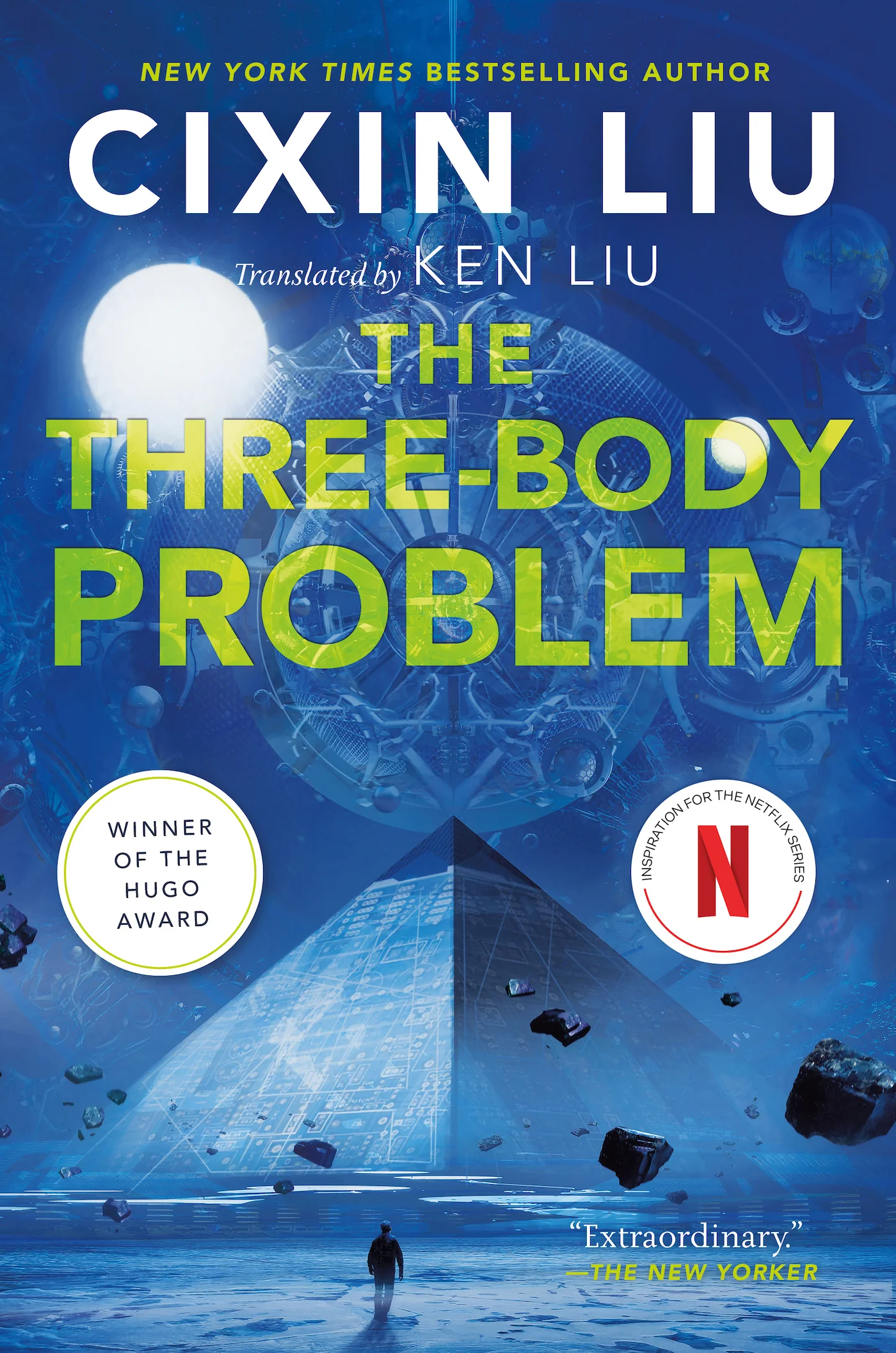
The Three-Body Problem
Synopsis
During China's Cultural Revolution, astrophysicist Ye Wenjie's experiences of political violence and persecution alter her view of humanity. Decades later, nanomaterials researcher Wang Miao is drawn into an investigation of physicists' deaths, apparently impossible experimental results, and an immersive game built around the unpredictable movements of three suns. The two timelines converge on a question with consequences well beyond any one scientist: what happens when human civilization learns it may not be alone?
Why It Fits
The novel makes a scientific mystery existential by linking the failure of familiar explanations to humanity's place in an unknown cosmos. Political persecution, environmental destruction, and mistrust shape the characters' willingness to seek answers beyond Earth. Discovery may expand knowledge while reducing confidence in humanity's security, judgment, and importance. Its dread is more intellectual and civilizational than supernatural.
Key Themes
- first contact and human significance
- political violence and disillusionment
- scientific knowledge and its limits
- civilization and survival
- trust and betrayal
- the ethics of communication
- uncertainty and cosmic scale
Who Should Read It
Start here if you want science-driven first contact, political history, unsettling scientific anomalies, and difficult choices about humanity's future. This is book one of the Remembrance of Earth's Past trilogy, followed by The Dark Forest and Death's End. Expect technical digressions, multiple timelines, and investigative suspense more often than traditional horror scenes.
Editorial Note
The novel was serialized in 2006 and appeared in book form in China in 2008; Ken Liu's English translation appeared in 2014. The catalog uses 2006 as the first-publication year for the serialized work and distinguishes that from book and translation dates. This is a spoiler-light discovery guide rather than a plot summary; a separate, source-audited overview and 35 chapter summaries are available on Chapter-Summaries.com.
Dread Index
Editorial classifications on a 0–5 scale. How the Dread Index works.
- Existential Dread
- 5 / 5
- Cosmic Insignificance
- 5 / 5
- Nihilism
- 3 / 5
- Isolation
- 4 / 5
- Identity Dissolution
- 2 / 5
- Reality Instability
- 4 / 5
- Mortality
- 4 / 5
- Philosophical Depth
- 5 / 5
- Gore
- 2 / 5
- Conventional Scares
- 2 / 5
- Difficulty
- 4 / 5
- Hopefulness
- 2 / 5
Why this score?
The possibility of extraterrestrial contact forces a reassessment of human agency and the future of civilization.
Why this score?
The novel places humanity beside a civilization and physical circumstances that do not privilege human survival.
Why this score?
Some characters lose confidence in humanity, but the novel also gives weight to inquiry, solidarity, and resistance.
Why this score?
Political persecution and scientific secrecy isolate individuals from the people and institutions they might otherwise trust.
Why this score?
Beliefs and allegiances change under pressure, but bodily or personal identity loss is not the book's principal mechanism.
Why this score?
Experiments and phenomena appear to contradict accepted explanations, threatening confidence in an orderly universe.
Why this score?
Personal violence and threats to humanity's future keep individual and collective survival in question.
Why this score?
The narrative integrates questions about science, history, responsibility, and whether contact is an ethical act.
Why this score?
There are serious violent events, especially in the historical storyline, but the book is not sustained graphic horror.
Why this score?
Countdowns and unexplained events generate suspense rather than frequent scenes of immediate terror.
Why this score?
Physics concepts, historical timelines, an intricate mystery, and changing points of view require sustained attention.
Why this score?
Human ingenuity and cooperation remain possible, but discoveries undermine easy confidence in a good outcome.