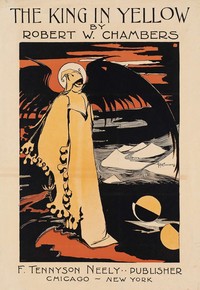
The King in Yellow
Synopsis
Robert W. Chambers's collection is best known for its opening stories, which are linked by a forbidden play called The King in Yellow, the Yellow Sign, and glimpses of the impossible city of Carcosa. Characters who encounter the play become obsessed, delusional, or exposed to realities that ordinary perception cannot safely contain. The later stories move away from overt horror toward romance and bohemian life, so the collection is stranger and less uniform than its reputation sometimes suggests.
Why It Fits
The opening stories are foundational weird fiction because forbidden knowledge alters the boundary between imagination, madness, and an external order that may be genuinely supernatural. The existential dread comes from losing confidence in perception and identity after encountering something that cannot be integrated into ordinary reality. Its cosmic horror is suggestive rather than systematic, which is part of its lasting influence.
Key Themes
- forbidden art and knowledge
- madness and perception
- decadence
- unreliable reality
- obsession
- art and influence
- cosmic intrusion
- identity
Who Should Read It
Read it if you want an early source for modern weird and cosmic horror, especially the traditions that later developed through Lovecraft and beyond. Expect nineteenth-century prose and a collection whose final stories are not all horror.
Editorial Note
The Dread Index scores the collection as a whole, not only the famous first four stories. That distinction matters: scoring only the Carcosa material would raise the cosmic, reality-instability, and conventional-scare dimensions.
Dread Index
Editorial classifications on a 0–5 scale. How the Dread Index works.
- Existential Dread
- 3 / 5
- Cosmic Insignificance
- 4 / 5
- Nihilism
- 3 / 5
- Isolation
- 3 / 5
- Identity Dissolution
- 4 / 5
- Reality Instability
- 5 / 5
- Mortality
- 3 / 5
- Philosophical Depth
- 3 / 5
- Gore
- 1 / 5
- Conventional Scares
- 3 / 5
- Difficulty
- 3 / 5
- Hopefulness
- 2 / 5
Why this score?
The strongest stories destabilize sanity and identity, though the collection does not sustain that pressure uniformly.
Why this score?
Carcosa and the King imply an external order beyond human understanding, but much of the collection remains human-scale.
Why this score?
Madness and corruption can make ordinary meaning collapse, yet the book as a whole does not advance a consistently nihilistic worldview.
Why this score?
Several protagonists become psychologically isolated by knowledge or obsession, but isolation is not universal across the collection.
Why this score?
The cursed play repeatedly destabilizes self-knowledge, sanity, and the boundary between delusion and revelation.
Why this score?
The opening stories deliberately make it impossible to know where madness ends and supernatural reality begins.
Why this score?
Death and doom are significant in the horror stories but less central across the entire collection.
Why this score?
The book is rich in interpretive questions about art, knowledge, and reality, though it is less explicitly philosophical than later existential horror.
Why this score?
The horror is primarily atmospheric and psychological rather than graphically violent.
Why this score?
Spectral figures, cursed texts, pursuit, madness, and supernatural threat create recognizable horror sequences in the opening stories.
Why this score?
The nineteenth-century style and tonal shift across the collection create some friction for modern readers.
Why this score?
The horror stories are bleak, while later romantic material prevents the whole collection from being uniformly hopeless.